How sampling works in private label cosmetics
What a sample actually proves, what it cannot prove, and why the ones that arrive fastest are usually the least useful to a launch decision.
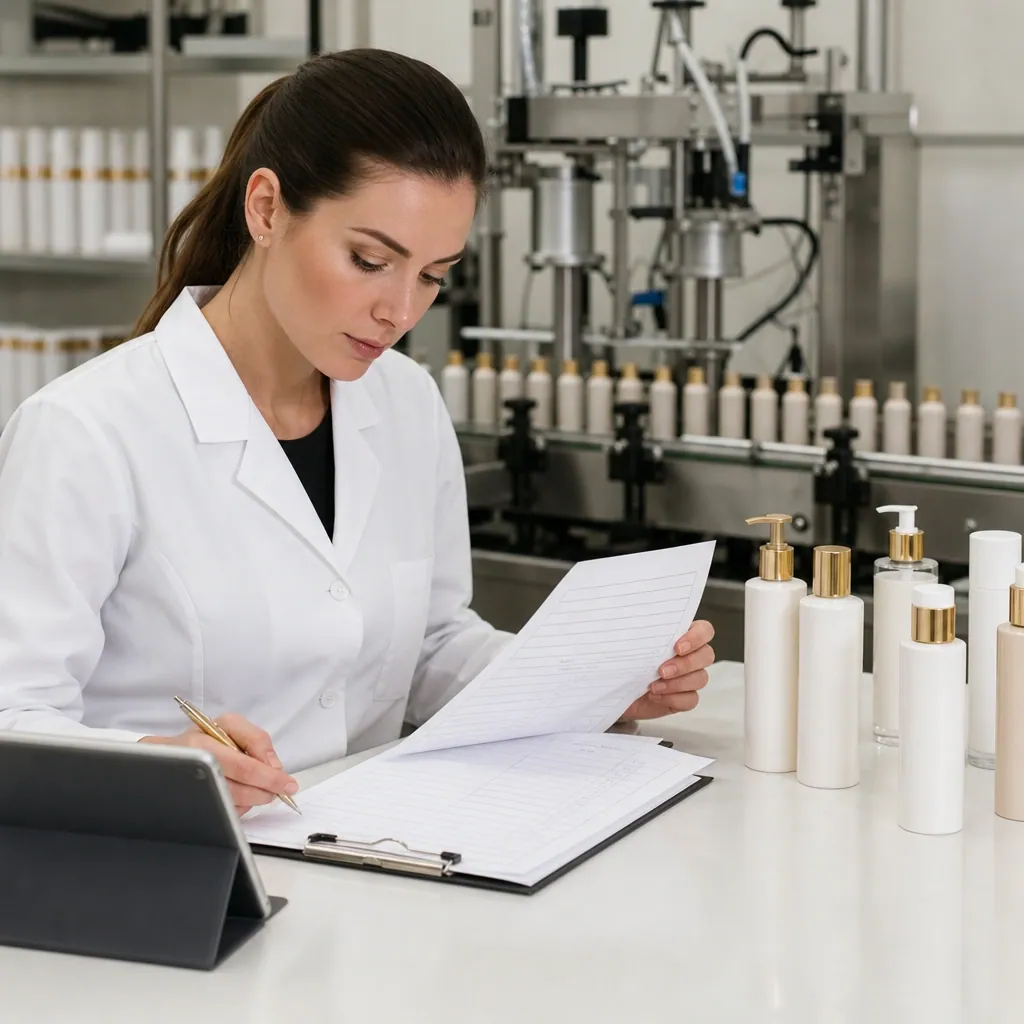
Almost every enquiry ends with the same line: “please send samples”. It sounds like a straightforward request. In practice, the sample is where a lot of launches quietly go wrong, because a sample is not a small version of your order — it is a separate production event with its own rules.
What a sample can tell you
The texture and the experience. How it pours, how it spreads, how it rinses, how it smells in the hand rather than in a description. This is the part nobody can assess from a specification sheet, and it is worth the wait.
Whether the packaging works with the formula. A pump that clogs on a viscous shampoo, a jar lid that does not seal against a rich mask, a tube that splits at the shoulder — these fail in the sample, not in the brief.
Whether the fill weight feels right in the hand. A 300 ml bottle that photographs well can feel cheap when you actually hold it. Buyers change fill sizes after holding the sample far more often than they change formulas.
What a sample cannot tell you
Stability. A sample produced this week says nothing about what the formula does after three months at 40 °C, or after a winter in an unheated warehouse. Stability is a separate test with its own timeline, and it is not something a courier envelope can answer.
Consistency between batches. One sample proves one batch. Whether batch fifty matches batch one depends on the component supply, the process control and the specification held on file — not on the sample in your hand.
That the packaging will be available at volume. Sample components are often pulled from stock that is nearly exhausted. The bottle in your hand may be the last of a run.
That the price will hold. A sample is quoted at sample cost. The production price depends on the component minimums, which is a different conversation.
The four kinds of sample, and what each is for
The stock sample. Pulled from an existing run, shipped in days. It tells you whether the direction is close. It does not tell you whether it is yours.
The lab sample. Mixed to your brief in small quantity. It tells you whether the formulator understood the request. Expect to pay for it, and expect it to arrive in unlabelled packaging.
The pilot batch. A small real production run on the actual line, with the actual components. This is the only sample that behaves like your order. It is slower and more expensive, and it is the one that prevents surprises.
The pre-production sample. Produced after artwork approval, in the final pack, for sign-off in writing. Not a marketing sample — a document.
Most buyers ask for the second and needed the third.
Why the fastest sample is often the least useful
If a supplier can send a finished, labelled, beautifully packaged sample within three days of your first message, one of three things is true: it was already made for someone else, it was made without your market in mind, or it is a stock item being described as custom.
None of those are necessarily bad — a stock sample is a legitimate first step. The problem is when it arrives presented as your sample, and the buyer approves it thinking the decision is made.
The questions to ask when a sample arrives
- Which batch is this from? A batch number is the difference between a sample and a souvenir.
- Was this formula or packaging changed for me? If yes, ask what changed and whether the change affects stability.
- Is the component in stock at the quantity we discussed? Ask before you design artwork around it.
- What would the production version differ in? Something usually does — the print method, the closure, the fill line.
- What is the approval step that commits both sides? Get it in writing before you plan a launch date.
The practical sequence
For most first orders the useful order is:
stock sample  →  narrows the direction, costs little
pilot batch   →  proves the real thing, costs real money
sign-off      →  formula version, pack, artwork, acceptance criteria
production
Skipping the middle step is the most common way to be surprised at the end. The pilot batch is where the fill line, the component and the formula meet for the first time — and where problems that a lab sample cannot show you become visible.
If you want to know what a sample route would look like for a specific direction, send the product, the market and the quantity range. We will tell you which of the four kinds of sample actually answers your question, and what it would cost. The contact form is five fields long, and the range shows what already exists.